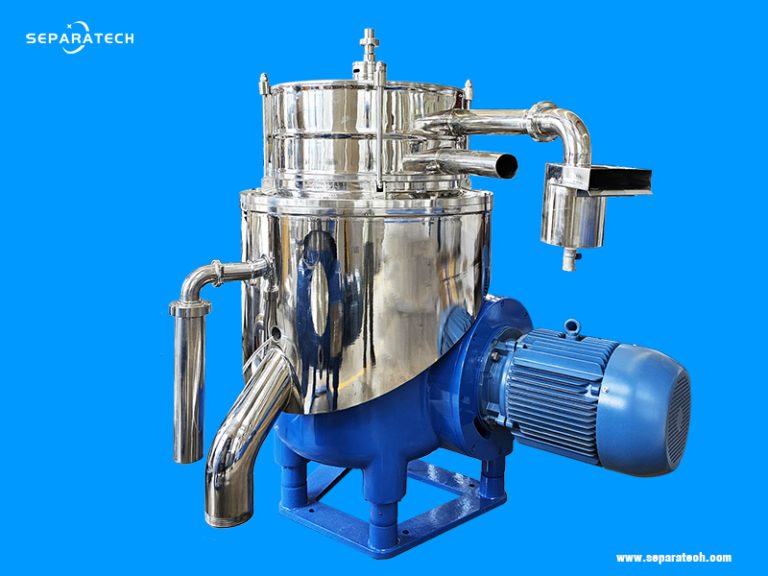
A tubular bowl centrifuge is a high-speed centrifugal separation device designed to separate mixtures of solids and liquids, or mixtures of liquids and solids and additional immiscible liquid phases. It operates by exploiting the differences in density among phases under a strong centrifugal field. Tubular bowl centrifuges are especially useful when:
• The solid particles are fine and present at low concentrations;
• The viscosities are moderate;
• The density differences between phases are relatively small;
• A high separation factor is required.
Below are the two principal separation modes: two-phase (liquid-solids), and three-phase (light liquid-heavy liquid-solids).

Two-Phase Separation (Liquid - Solids)
Structure
In the two-phase version (often referred to as “solid–liquid” separation, denoted “GQ” type tubular centrifuge in some manufacturers’ nomenclature) the tubular bowl centrifuge consists essentially of:
• A rapidly rotating tubular bowl (sometimes elongated, narrow tube shape inside a larger shell), enclosed in a housing;
• Liquid inlet (feed) at (typically) the bottom or near the base of the bowl;
• A mechanism (motor + drive) to spin the bowl at high RPM to generate high centrifugal acceleration (many thousands of times gravity) inside the bowl;
• A clarified liquid discharge outlet (often at the top or upper side of the bowl);
• A solids deposition surface (the wall of the tubular bowl), where solids accumulate;
• A means to shut-down or stop the machine periodically to manually remove the accumulated solids (“cake” or “slag”) when the solids layer becomes too thick or begins to impair separation.
Operation / Process Flow
1. Feed introduction: The slurry (liquid + suspended solids) is fed into the bowl from the lower inlet.
2. Accelerated rotation: The bowl is rotated at high speed, creating a strong radial (centrifugal) force field.
3. Phase separation:
o The suspended solid particles, being of higher density than the liquid, are forced outward toward the inner wall of the bowl.
o The clarified liquid (or supernatant) remains in the interior and is allowed to flow upward / outward toward the liquid discharge outlet.
4. Liquid discharge: The clarified liquid exits continuously via the liquid outlet(s) located near the top portion of the bowl.
5. Solid accumulation & removal: Solids accumulate on the bowl wall. Once the solids layer reaches a design or operational limit (affecting liquid clarity or reducing bowl capacity), the centrifuge is shut down and the solids are manually removed.
Three-Phase Separation (Light Liquid - Heavy Liquid - Solids)
This configuration (sometimes called “GF” type tubular centrifuge in some manufacturers’ literature) accommodates separation of three immiscible phases: a heavy liquid, a lighter liquid, and solids. Common examples are oil/water/solid slurries, or organic solvent/water/sludge mixtures.
Structure Additions / Modifications
In addition to the components already present in the two-phase version, the three-phase version includes:
• Additional discharge outlets for each liquid phase (heavy liquid outlet and light liquid outlet), often positioned so that the heavier liquid (with higher density) exits through one outlet, light liquid through another. These are often located in the upper portion of the bowl.
• Internal design or flow paths that permit stratification of liquids inside the tubular bowl centrifuge bowl: the heaviest liquid forms the outer layer (closest to bowl wall), the lighter liquid an inner layer, and solids trapped at or near the wall.
• Sufficient design control over flow rates, feed composition, and rotational speed so that the liquid–liquid interface is well established and stable.
Operation / Process Flow
1. Feed introduction: The mixed feed (containing solids plus two immiscible liquids) enters near the bottom.
2. Centrifugal stratification: Under high speed, three distinct layers form due to density differences:
o Outermost: solids (highest density) forced outward against the bowl wall;
o Between: the heavier of the two liquids forms a ring just inside the solids layer;
o Inner ring / core: the lighter liquid occupies the innermost region (closest to the axis).
3. Liquid discharge:
o The heavier liquid is collected and discharged via its dedicated outlet (often one positioned in the wall region or upper portion but designed for that layer).
o The lighter liquid exits via its outlet, usually nearer to the axis or at a location corresponding to its layer in the radial cross section.
4. Solid separation: As with the two-phase mode, solids accumulate on the bowl wall as a sediment or cake. Periodically, the centrifuge must be shut down so the solids can be removed.
Key Performance Parameters & Design Considerations
To ensure efficient separation in both modes, the following parameters are critical:
• Rotational speed / G-force: Higher speeds increase the centrifugal field, improve sedimentation of fine particles, improve phase separation.
• Residence time / flow rate: There must be enough time under the centrifugal field for particles to settle; too high a flow rate may reduce separation efficiency.
• Density difference between phases: Larger differences make separation easier; smaller differences require higher G or more careful feed prep.
• Particle size and distribution: Finer solids are harder to remove; design must accommodate the expected particle size.
• Viscosity of liquids: Higher viscosity slows down settling and can blur interfaces.
• Feed concentration of solids: Low solids content helps in keeping clarity and preventing clogging; high solids may overload the sediment layer.
• Temperature, corrosion, material compatibility: For certain feeds (chemical, food, pharmaceutical), materials and seals must resist corrosion; sometimes cooling jackets or heat control are needed.
• Shutdown/purge design: Ease of stopping and accessing the bowl to remove solids, safety, and cleaning.
Main structure of tubular bowl centrifuge
Bowl
The tubular bowl centrifuge bowl is the core component of the tubular centrifuge. It is essentially a cylinder with a drainable but non-removable top cover on the top and a removable bottom cover for unloading and cleaning. There is a sealing ring between the bottom cover and the cylinder, and there are triangular or quadrangular plates inside the cylinder.
The threads and stoppers on the top of the bowl are used to connect the nut and the spindle, and to position the bowl. To ensure the coaxiality of the spindle and the bowl after connection, please be sure to protect the threads and stoppers.
If a three-leaf plate is installed, its relative position to the bowl is fixed to ensure balance. The edge with the mark must be aligned with the mark on the cylinder and pushed into the cylinder until it is fully pushed in.
If it is a four-sided plate, be careful not to loosen the four-sided plate during installation and disassembly, as its connecting thread is left-handed.
The bowl is carefully balanced. During the balance, the lower cover with qualified sealing ring is tightened with the cylinder body to determine the reference mark. Due to slight changes in the thickness of the gasket, the lower cover and the cylinder body mark will be slightly misaligned when tightened. The maximum misalignment should not exceed 10mm, and is generally required to be within ±10mm. If it exceeds the tolerance, the sealing ring should be replaced. replaceable liner on the head of the lower end cover. When the bowl runs over the critical value or the amplitude is slightly large, the liner will slide in contact with the sliding bearing, so its surface is required to be smooth and have appropriate hardness and wear resistance. If there are scratches on the surface, it must be polished with sandpaper. When the diameter wear reaches 0.5mm or the scratch depth reaches 0.2mm, it must be replaced. Excessive wear will damage the fine thread on the lower cover.
The cylinder and the lower cover have matching surfaces and are connected by trapezoidal threads. Since both are made of stainless steel, it is easy to cause biting. If separation is allowed, special lubricants can be applied before each assembly. If biting occurs, professionals must be asked to perform a little scraping and grinding, or the machine manufacturer must be commissioned to repair it.
If the lower bearing clearance is not properly matched or the machine vibrates too much, the lower cover feed position will rub against the feed nozzle. The cause should be found out and prevented. If there is friction damage, it should be repaired in time. When the damage depth exceeds 0.8mm, the tubular bowl centrifuge manufacturer – SEPARATECH should be entrusted to conduct a safety inspection.

Head assembly

The tubular bowl centrifuge spindle is supported on the bearing shaft with two ball bearings through a spherical rubber pad. The pulley torque drives the spindle through the rectangular cross pin, and the bowl rotates. The upper bearing is radially aligned and positioned, and the lower bearing is subjected to the axial force of the machine. Therefore, reasonable lubrication is required. The so-called reasonable lubrication means that the grease should be clean and filled in an appropriate amount, generally not exceeding 75% of the gap in the bearing. Too much grease will significantly increase the temperature rise. The coaxiality of the new spindle should be ≤0.03mm, and the wear of the cross sleeve and the rectangular cross pin should not exceed 0.10mm. The pulley cross sleeve is tightened with a “T” wrench and the set screw is installed. The rubber pad can be evenly tightened with a blunt tool, but the rubber should be prevented from tearing. A little lubricating oil or grease can be applied to the spindle insertion end. The rectangular cross pin has an interference fit with the hole on the shaft, and the exposed part should be basically symmetrical.
Lower bearing assembly
the lower bearing assembly is to ensure that the sliding bearing can move flexibly when the force is applied evenly in all directions. Therefore, no sharp edges or burrs are allowed on the moving cylindrical and flat surfaces of the end face, the contact surface between the sliding bearing sleeve and the bearing seat must maintain smooth contact, the clearance between the sliding bearing and the liner must be within the required range, and all parts must be properly lubricated. The lower bearing is installed into the fuselage and locked by the left and right handles. Therefore, as long as the assembly is installed into the fuselage, it must be ensured that the two handles are locked in the downward position. Unless disassembled or assembled, the downward position of the two handles must not change. The feed input pipe can be installed after the bowl and lower bearing are installed. Pay attention to whether the input pipe aperture and outer circle match meet the requirements. After installing the input pipe, install the feeding device and tighten the feed nut with a special wrench.

Pressing wheel of tubular bowl centrifuge

In a tubular bowl centrifuge, the pressing wheel is a critical component designed to optimize the belt drive system. Since the speeds of the large and small pulleys are relatively high, the pressing wheel improves the belt wrap angle, enhancing grip and increasing the transmitted torque. This ensures smooth and efficient power transfer to the centrifuge bowl. The component must provide appropriate and constant tension to the belt, typically achieved by a torsion spring, and its surface must remain smooth to minimize friction, reduce wear, and ensure light, stable operation. Proper maintenance of the pressing wheel is essential for the reliable performance of a tubular bowl centrifuge, as it directly affects separation efficiency and operational safety.
If you would like to gain a deeper understanding of the working principle and main structural design of tubular bowl centrifuges, we encourage you to reach out to SEPARATECH. Our team of specialists can provide detailed technical explanations, application insights, and tailored recommendations based on your process requirements. Whether you are interested in liquid-solids clarification or light liquid-heavy liquid-solids three-phase separation, SEPARATECH will be glad to share expertise and practical experience to help you select the most suitable centrifuge solution for your industry.